Sangh swayamsevaks reached over ten crore homes; direct Sangh work now at more than one lakh places
Total Views |


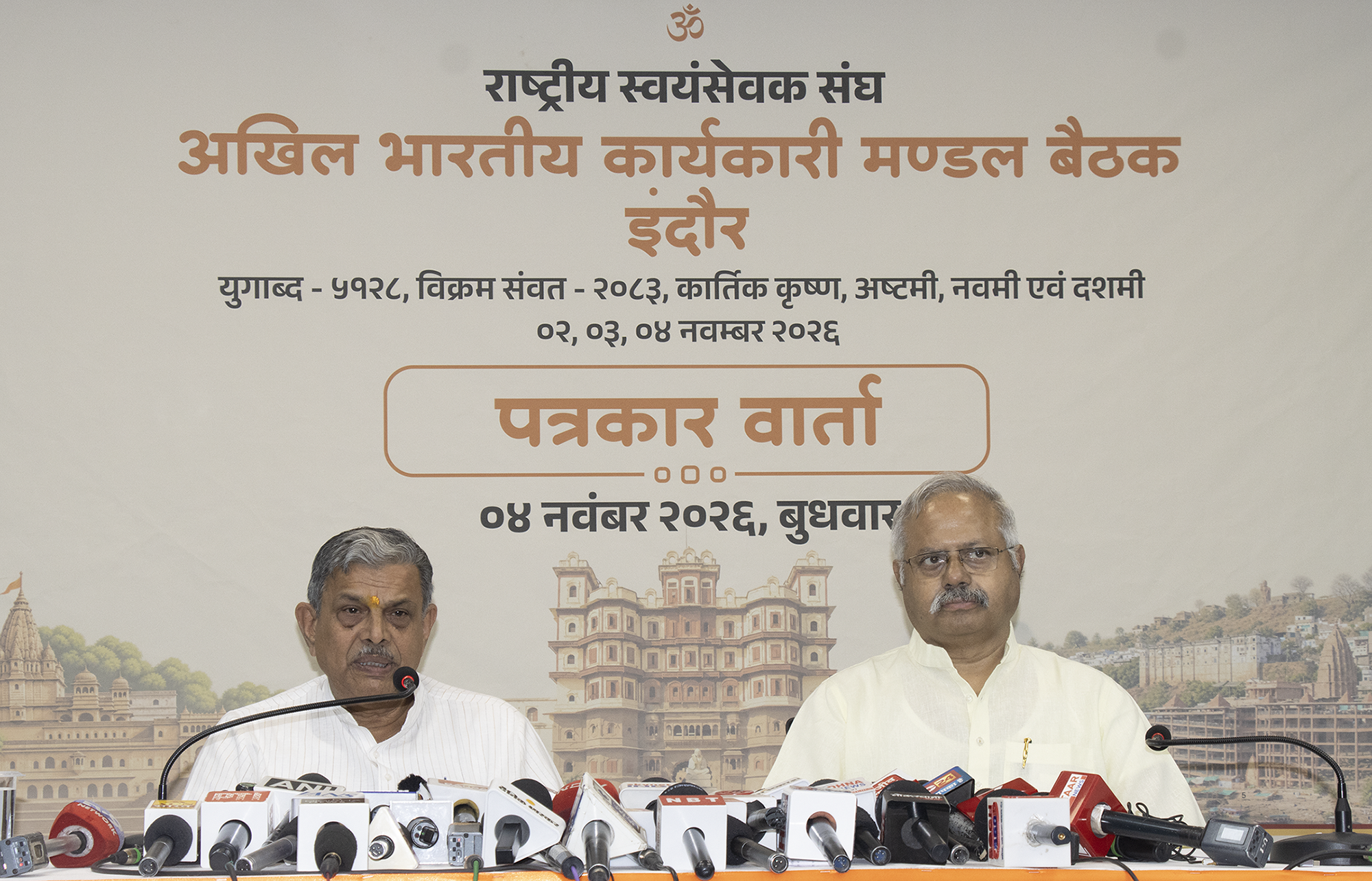
Annual Akhil Bharatiya Karyakari Mandal meeting of Rashtriya Swayamsevak Sangh concludes
Review of centenary year programmes, implementation of Panch Parivartan, and deliberation and planning on shakha expansion and social awakening
Indore, 04 November 2026.
The annual Akhil Bharatiya Karyakari Mandal meeting of the Rashtriya Swayamsevak Sangh concluded in Indore. On the final day of the meeting, Sarkaryavah Dattatreya Hosabale Ji addressed journalists and answered their questions. At the beginning of the press conference, Sarkaryavah Ji thanked the management of Daly College for the arrangements and media colleagues for positively publicising the Karyakari Mandal meeting and the Sangh’s subject among society, and extended Diwali greetings.
Sarkaryavah Dattatreya Hosabale informed that out of 406 expected karyakartas from across the country, 398 karyakartas were present in the meeting. As every year, this meeting, held between Dussehra and Diwali, presented the account of programmes organised in the centenary year. The centenary year programmes were completed with broad cooperation from society. This was an opportunity to introduce the Sangh to society’s sajjan shakti.
Participation of swayamsevaks in service work
At times of natural disasters at different places in Bharat, swayamsevaks there, together with social organisations and society, attempted to provide service at different places.
In Chitrakoot life and livelihood of so many people got affected due to excessive flooding in the Mandakini river, there 350 karyakartas went house-to-house and distributed relief kits to the affected city and rural families. Permanent arrangements were run for food for more than 6000 people. Medical care was provided to 5600 people. Along with this, efforts were also made for vaccination of animals.
In the Lucknow region, in the severe flood situation due to excessive rainfall in the city, more than 300 karyakartas distributed food, water, medicines and other life-utility items to the affected families.
In the flood-affected region of Sivasagar and Jorhat districts of Assam, more than 1600 swayamsevaks provided food, water, medicines and other assistance to 42,200 families. This service work was done by collecting more than Rs 5 crore.
In Odisha and Andhra region, due to the Arnab cyclone, in the entire region connected to the sea coast, in Kandhamal, Ganjam, Srikakulam, Vijayawada districts, the swayamsevaks there, taking society along, are active for various aid to the victims.
Work Expansion: Direct Sangh work at more than one lakh places
In the centenary year, along with reviewing the shakha expansion done by swayamsevaks, deliberations were also held on making the shakhas more effective and regular, strengthening them, and starting shakhas at more and more places.
In the country, 99,423 daily shakhas are being held at a total of 63,208 places. This year, the number of daily shakhas increased by 12,025 and shakha places increased by 8,156 places. A total of 34,982 weekly milans are being held at 26,826 places and 14,096 monthly Mandalis are being held at 13,363 places. The number of weekly milans increased by 2,712 and the number of monthly Mandalis increased by 463. Compared to 93,156 total places last year, this year a total of 1,03,397 places are with direct Sangh work.
In the Sangh’s geographical structure, now instead of 46 prants, there will be 88 Sambhags.
Centenary year programme account: Contact in more than ten crore homes
The programmes organised from Vijayadashami 2025 to Vijayadashami 2026 under the centenary year were reviewed. Deliberations were held on their future implementation, follow-up, and reaching different sections of society through them. Especially, discussions were held on the action plan for effectively bringing the initiatives of Panch Parivartan into the practice of society and their continuous follow-up.
In the centenary year, various programmes were organised with a view to expanding and taking the Sangh, Hindutva and Panch Parivartan thought to society.
Hindu Sammelan -- Hindu Sammelans were organised with the aim to bring people together, social harmony, mutual cooperation and positive lifestyle, where 4,93,76,694 people from all sections of society participated, in which participation of more than two and a quarter crore woman is noteworthy. A total of 65,664 Hindu Sammelans were organised in 37,080 rural mandals and 28,584 urban bastis where people from 3,08,449 villages participated. Hindu Sammelans were also organised at places like Arunachal Pradesh, Ladakh and Andaman.
Griha Sampark -- Taking the Sangh’s hundred years’ journey and Sangh thought, karyakartas organised a Griha Sampark (home-to-home contact) campaign. In a total of 4,63,340 villages and 41,825 urban bastis, teams of Sangh karyakartas reached 10,22,05,665 homes. In Griha Sampark, karyakartas sat and discussed for 15 to 20 minutes in each home.
Youth Programmes -- In the centenary year, a total of 31,26,404 students participated in 57,243 programmes organised at 21,237 places for college students. Similarly, a total of 6,90,835 young workings people participated in 14,285 programmes. In this way, a total of 38,17,239 youths were directly present in these programmes.
Pramukh Jan Goshthi (seminars for important people from different walks of life) -- In 3,207 Pramukh Jan Goshthis organised at district centres and other prominent places, 4,29,262 prominent society members participated.
Samajik Sadbhav Baithak -- With a view to working for harmony, cooperation, a discrimination-free society among different sections of society and solving social challenges together, Samajik Sadbhav Baithaks of brothers and sisters leading society were organised. A total of 8,346 Samajik Sadbhav Baithaks were organised in 5,028 rural khands and 3,318 towns across the country, in which 3,79,581 society pramukhs including 36,916 women participated.
Special efforts to stop the spread of drugs among youth
The whole society and government are concerned about the increasing spread of drugs among youth. The Sangh, with the cooperation of social organisations, urges everyone to save youth from intoxicants. The work of saving from the international conspiracy of drug trade is being taken by the administration and government. The Home Ministry is doing special work in this subject. In the meeting, a plan was made to work with social organisations in social awareness against drugs and rehabilitation.
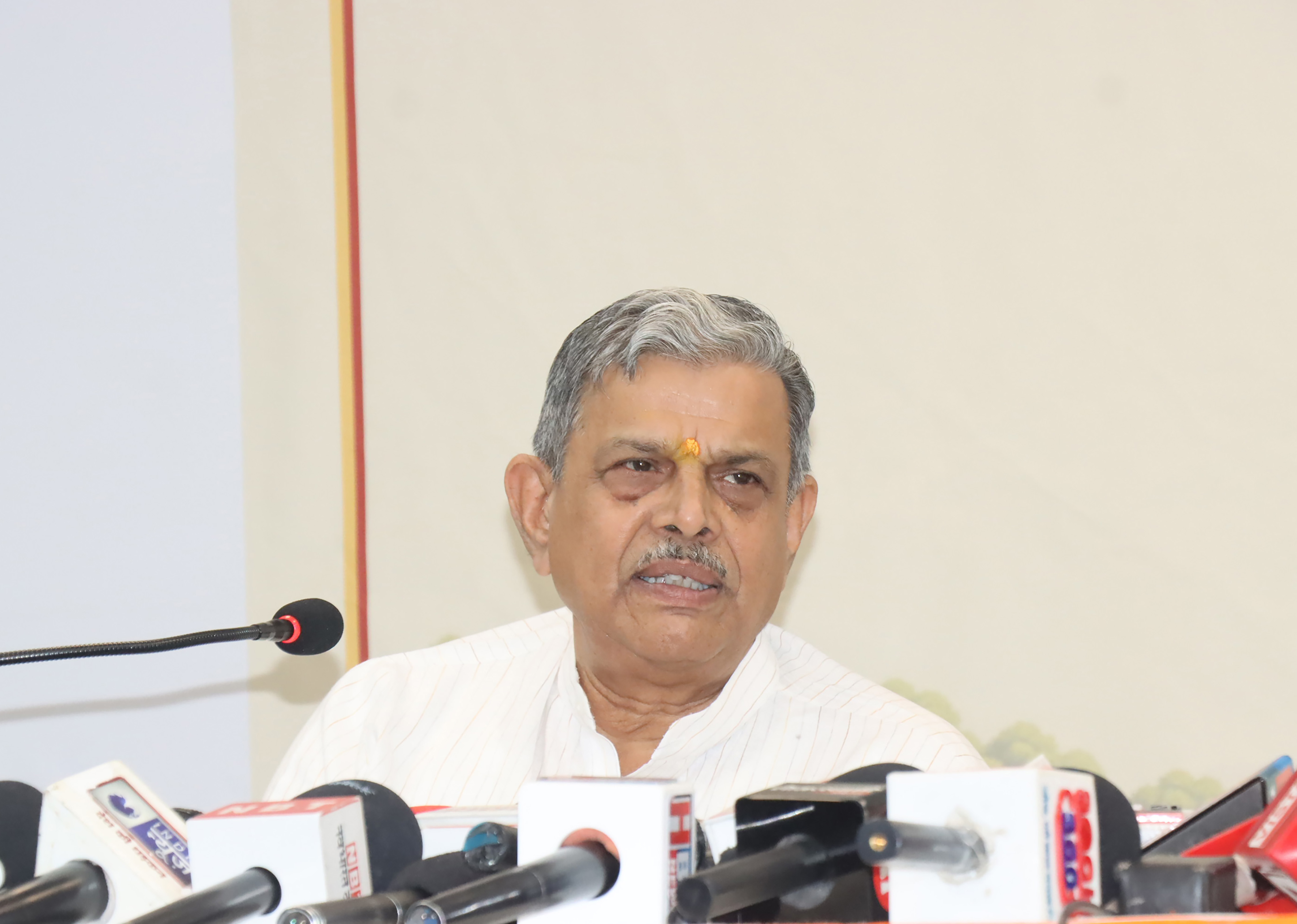
Sarkaryavah Ji’s statements on three prominent personalities
In the meeting, statements were issued by Sarkaryavah Dattatreya Hosabale ji regarding three important historical and inspiring personalities.
1. On the occasion of the 200th birth anniversary of Shri Rajnarayan Basu, pioneer of national consciousness, in the statement issued remembering his life and contribution, his special efforts in upliftment of the poor, drug de-addiction, spread of education among women and remarriage of widows, including protection of Swadeshi, Swa-bhasha and Swa-dharma, were remembered.
2. On the occasion of the 100th year of the sacrifice of Swami Shraddhanand ji, pioneer of the Shuddhi movement, in the statement remembering his life, work and contribution, homage was paid to him by Sarkaryavah ji.
3. On the occasion of the 100th year of the birth of Swami Lakshmananand Saraswati ji, who dedicated his life for awakening of self-respect, self-reliance and Swadharma in the tribal region of Kandhamal, Odisha, his sacred memory was recalled in the statement of Sarkaryavah ji. Swami Lakshmananand ji’s life was dedicated to self-reliance of the tribal region through Sanskrit education, women’s bhajan kendra, cow protection, agriculture and water conservation.
He propagated an easy path of ghar wapsi through Dharani penu Puja, Nirmalya of Jagannath ji, Ganga Jal and soil and leaves of Tulsi plant.
Foreign tour of Sarsanghchalak ji
In the August-September tour of three countries by Sarsanghchalak ji, an effort was made to give Bharat’s message for world unity and human unity. In this tour, Sarsanghchalak ji met prominent local people of various fields of life in person and in groups, which included dialogue with scholars of prominent universities. He also went to Swami Narayan temple, Khalsa Gurudwara and Jain temple. People abroad were curious to understand the Sangh’s method of karyakarta construction, Hindutva and Bharat’s concept of nationality. Sarsanghchalak ji also held dialogue on related issues.
Answering journalists’ questions, Sarkaryavah ji said that it is not possible to stop technology. About the spread of unnecessary content on social media, if the government can make a law, by wider consultation with social and religious leadership, then it should take necessary decisions. The Sangh insists on sanskar and discipline in the family. Leaving mobile phones aside, there should be discussion on positive subjects together in the family. The family will have to take responsibility for teaching life values and sanskar to society. We must take the five initiatives of Panch Parivartan to society.
In answer to a question related to democracy and Gen Z, he said that there is an election system in the country for change of power. This work through anarchy, unrest is not in the interest of the country. Such conspiracies are going on in Bharat and abroad, we should remain alert about them. There should be dialogue on the aspirations of youth. There should be positive deliberations with the new generation. A feeling of anger comes in youth, it should be channelised properly. They should be saved from anarchic conspiracy, and their aspirations should be understood. Youth are endowed with energy, social sensitivity and service spirit, efforts should be made to connect them with positive work. Anarchic forces should not dominate in Bharat and inactivity of Sajjan Shakti good-thinking people in society gives strength to anarchy, therefore sajjan shakti will have to become active.
Answering a question related to the registration of the Sangh, Sarkaryavah ji said that society and Sangh are not separate, our work is to organise the whole society itself, therefore Sangh is working within constitutional arrangements.
In all works of Panch Parivartan and social transformation, participation of women is increasing, even the imagination of society is not possible leaving women aside. The Sangh’s work, run with the approval of society, is also growing in difficult areas like Arunachal, Mizoram, Tripura and challenging areas like Kerala and West Bengal.